
Profiles & Estimates
CAREX Canada has developed profiles and estimates of occupational and environmental exposure for a number of known, probable, and possible carcinogenic agents. The profiles detail carcinogenic evidence, main uses, regulatory information, and the potential for exposure to the Canadian population. The environmental exposure estimates have detailed information on where people in Canada are exposed, at the national and provincial levels. The occupational exposure estimates calculate the numbers of workers exposed by industry and occupation, and where data exist, levels of exposure are estimated. Detailed information about data sources and methods are available for all estimates and profiles.
Looking for information about a substance that’s not listed here? It might be profiled on our Emerging Issues page.
Profiles & Estimates
CAREX Canada has developed profiles and estimates of occupational and environmental exposure for a number of known, probable, and possible carcinogenic agents. The profiles detail carcinogenic evidence, main uses, regulatory information, and the potential for exposure to the Canadian population. The environmental exposure estimates have detailed information on where people in Canada are exposed, at the national and provincial levels. The occupational exposure estimates calculate the numbers of workers exposed by industry and occupation, and where data exist, levels of exposure are estimated. Detailed information about data sources and methods are available for all estimates and profiles.
Looking for information about a substance that’s not listed here? It might be profiled on our Emerging Issues page.





























































Classifying Carcinogens
CAREX Canada classifies carcinogens based on evaluations made by the International Agency for Research on Cancer (IARC). IARC has classified more than 1,000 agents into different groups based on their carcinogenicity to humans. These agents include pure chemicals and chemical mixtures, occupational exposures, physical agents, biological agents, and lifestyle factors.
The most important IARC carcinogen categories for CAREX Canada are Group 1 and Group 2A. Group 1 agents were evaluated by IARC as “carcinogenic to humans” based on “sufficient evidence of carcinogenicity in humans.” Carcinogens such as asbestos, benzene, wood dust, and diesel exhaust are Group 1 agents. The Group 2A category includes agents that are “probably carcinogenic to humans” based on “limited evidence of carcinogenicity in humans and sufficient evidence of carcinogenicity in experimental animals.” Carcinogens/exposures such as shiftwork, creosotes and acrylamide are Group 2A agents.
IARC Group 2B agents are “possibly carcinogenic humans” for which there is “limited evidence of carcinogenicity in humans and less than sufficient evidence of carcinogenicity in experimental animals.” Some pesticides used in Canada, such as Chlorothalonil and MCPP, fall into this category.
IARC also considers mechanistic data when assessing the carcinogenicity of different hazards. Ten key characteristics of carcinogens have been identified by IARC and can be found here.
Prioritizing Canadians’ Exposures to Carcinogens
Overall, CAREX Canada aims to determine where Canadian exposures to carcinogens are occurring, the number of Canadians exposed to different carcinogens and their levels of exposure. One of our first tasks was to prioritize which agents to focus on, as many IARC classified agents occur in environmental and occupational settings in Canada. CAREX Canada categorized IARC agents into four priority groups: immediate high priority; possible high priority; moderate priority with further substantial investigation warranted; and low priority with no evidence of use in Canada. There were three criteria considered in this prioritization process:
- The carcinogenicity and other toxic properties of the agent.
- The prevalence of exposure in Canada.
- The feasibility of assessing exposure in Canada.
Two documents, one for environmental and one for occupational carcinogens, have been produced to summarize the prioritization methods and results in detail:
Environmental Approach
Our goal is to estimate Canadians’ potential exposures to the most common known or suspected carcinogens in community settings outside of work. This includes exposures via outdoor air, indoor air and dust at home, drinking water, and foods and beverages. We use a risk-based approach to produce indicators of potential lifetime excess cancer risk circa 2011. This allows us to compare substances and exposure pathways, and supports priority setting for exposure reduction or elimination activities. The indicators typically show a national average and maximum lifetime excess cancer risk, based on actual measured data, for each substance and exposure pathway.
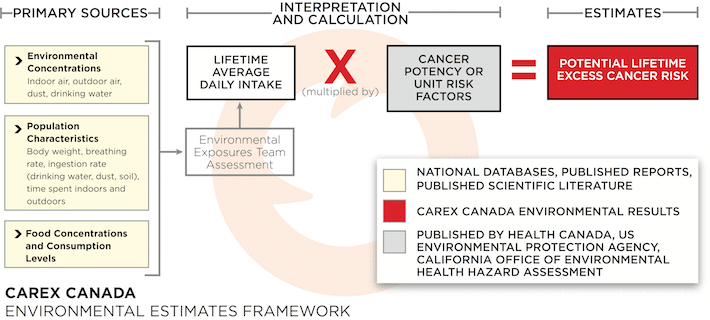
Potential lifetime excess cancer risk is calculated by multiplying intake (the amount inhaled or ingested) by a cancer potency factor or unit risk factor. For most substances, we estimated average and maximum intake using standard breathing and ingestion rates along with average and maximum measured levels in each exposure pathway (except food and beverages).
The indicators are general estimates, and do not represent an actual risk for any specific Canadian. We assume that exposure occurs at the same level, 24 hours per day, for 70 years. This is rarely true for any single individual, but using a standard set of assumptions allows us to provide a relative ranking for known and suspected carcinogens across exposure pathways. At any one place, measured levels may change due to changes in source emissions. For any one person, intake may change over time, or as they move from place to place or change their habits.
We have also developed highly detailed maps of known and suspected carcinogen concentrations in outdoor air across Canada.
More information on these methods are available in the documents below:
- Methods for Lifetime Excess Cancer Risk Estimates – Environmental Exposures [PDF] *Applies to all LECR estimates except asbestos and radon
- Asbestos Methods for Lifetime Excess Cancer Risk Estimates – Environmental Exposures [PDF]
- Radon Methods for Lifetime Excess Cancer Risk Estimates – Environmental Exposures [PDF]
- Mapping Methods [PDF]
Occupational Approach
Our goal is to estimate Canadians’ potential exposures to known and suspected carcinogens in the workplace. Estimates of the numbers of workers exposed to specific carcinogens have been calculated by industry, occupation, province, and sex. Where data are available, levels of exposure expected in Canadian workplaces have also been estimated. These estimates are important for developing prevention strategies for cancer and other occupational diseases, for targeting high-risk groups, for determining the occupational burden of cancer in Canada, and for creating new epidemiological studies that are able to increase our ability to recognize and prevent occupational cancers.
Our estimates are produced following a general approach to ensure transparency, scientific rigor, ease of interpretation, and comparability between substances. The approach is flexible, and may be adjusted for substances with unique data sources or particular challenges with respect to uncertainty. For instance, we used a modified approach to assess occupational exposure to antineoplastic agents and solar ultraviolet radiation.
CAREX Canada is committed to providing estimates that are as accurate as possible. A challenge that we face is a general lack of current occupational exposure data. This may affect both our prevalence estimates and levels of exposure estimates, especially when the use of a substance has changed substantially since the 1990s. We welcome comments and additional data sources from researchers and other stakeholders in occupational health.
Exposure prevalence estimates approach
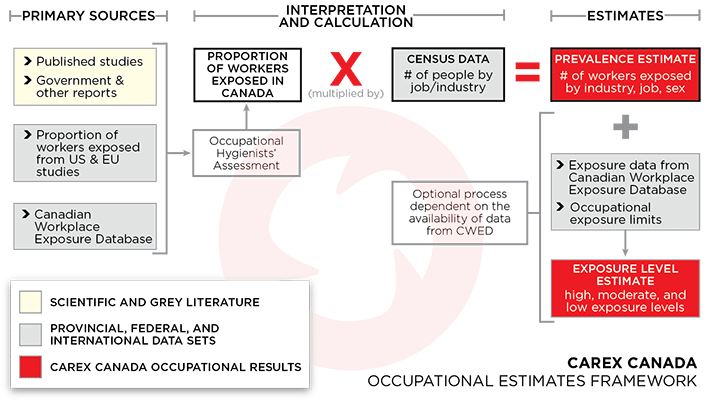
To generate the exposure prevalence estimates, we combined information gathered in a scientific literature review, data included in the Canadian Workplace Exposure Database (CWED), information from previous CAREX projects in Europe, Canadian-specific information on exposure from government and other sources, and CAREX occupational hygienists’ expert assessment. The main goal of the information collection was to gather current information on Canadian uses of a substance, potential industries and occupations where exposure may occur, and exposure circumstances. Where exposure data is available in the CWED, we identified industries and occupations where exposure has been measured. This allowed us to confirm exposed jobs and industries flagged during our literature review, and to flag new industries that we had not originally considered.
Level of exposure estimates approach
For substances with sufficient Canadian exposure measurement data in the CWED, we generated estimates of the level of exposure. Exposure concentration thresholds relevant to workplace exposure limits and cancer health outcomes were selected for each of these substances. Based on the number of measurements available in the CWED and their concentrations, exposure may be categorized into three categories: low, moderate, or high. Details of the categorization criteria are available for each substance with exposure level estimates, such as wood dust and benzene.
2016 Update
In 2021, we updated our 2006 occupational exposure estimates using the Statistics Canada 2016 Census of Population. The 2006 proportions of workers exposed in each industry and occupation, as well as levels of exposure, were adjusted as needed based on changes to (1) the industry and occupation classification systems used in 2006 and 2016, and (2) carcinogen exposures over time. Finalized proportions were then applied to 2016 labour force data to produce the updated estimates of workplace exposure.
The Statistics Canada 2016 Census of Population describes the labour force using the North American Industry Classification System (NAICS) Canada 2012 and the National Occupational Classification (NOC) 2016 coding systems. Because our previous exposure estimates used the NAICS 2002 and the NOC-S 2006 coding systems, concordances between classifications were used to identify changes in how the industries and occupations were classified between years. Only minor changes occurred in the industry coding systems from 2002 to 2012. However, several occupation codes were combined or separated when updated from NOC-S 2006 to the 2016 NOC coding systems.
We conducted a literature scan and key informant interviews to identify how carcinogen exposures may have changed from 2006 to 2016. For example, exposure estimates were adjusted if a new policy, practice, or use reduced or increased workers’ exposure to a specific carcinogen. For most exposures, no significant changes in workplaces practices were identified that would have changed the proportions exposed.
Many of the changes observed in the 2016 estimates reflect the changes in the Canadian labour force. If the number of workers in an industry and/or occupation increases or decreases, the number of workers exposed to a substance found in that industry and/or occupation will also change. From 2006 to 2016, the overall number of workers in the labour force increased by approximately 8%, or 1.4 million workers. The industries (NAICS 2-digit) with the largest increase in number of workers include health care and social assistance (422,000 workers, +25%), construction (296,000, +28%), and professional, scientific, and technical services (213,000 workers, +19%). Management of companies saw the largest percent increase, with 40% (8,300) more workers. The industries with the largest decrease in number of workers in the labour force include manufacturing (-409,000 workers, -20%) and agriculture (-79,000 workers, -15%).
Changes in the number of workers in the Canadian labour force from 2006 to 2016 by industry
For more information on the approach for a specific substance, visit the Methods and Data tab for occupational exposures on each carcinogen profile.
Canadian Workplace Exposure Database
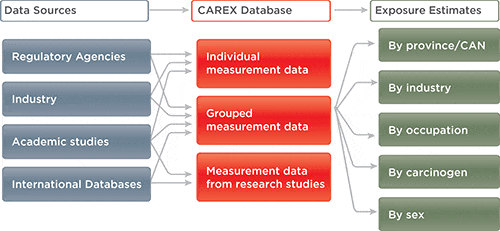
The Canadian Workplace Exposure Database (CWED) is a national exposure database that has been created as an important part of CAREX Canada. The CWED contains measurement data on exposure to known, probable and possible carcinogens in Canada from a variety of sources.
Data from the CWED is useful for both cancer prevention and research. Some examples of how the CWED can be used are shown below.
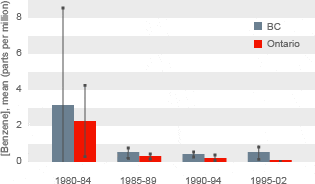
Changes in Benzene Over Time
Workplace exposure data from BC and Ontario show that exposure to benzene declined over the 1980s. This could be due to the reduction of allowable benzene in gasoline in the late 1980s in Canada. The CWED could help show the impact of regulatory change on workers’ exposure to carcinogens.
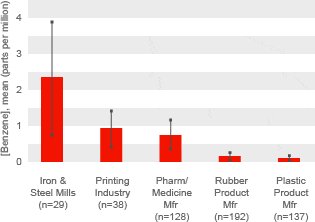
Industry-specific Differences in Exposure to Benzene
This chart shows the mean benzene concentrations in the workplaces most frequently sampled for benzene in Ontario between 1981 and 1996. The CWED helps to identify at-risk groups of workers to target educational, regulatory, or other prevention efforts. Industries with higher exposure are not necessarily the most frequently sampled. CWED can also be used to identify industries where further data need to be collected.
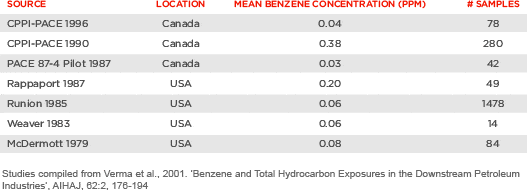
External Sources of Benzene Exposure Data
Workers in gasoline stations are at risk of exposure to benzene, but in BC and Ontario, very few samples have been taken. In these cases, external data (from other agencies, countries, or published literature) can be used in the CWED to estimate exposure.
Subscribe to our newsletters
The CAREX Canada team offers two regular newsletters: the biannual e-Bulletin summarizing information on upcoming webinars, new publications, and updates to estimates and tools; and the monthly Carcinogens in the News, a digest of media articles, government reports, and academic literature related to the carcinogens we’ve classified as important for surveillance in Canada. Sign up for one or both of these newsletters below.
CAREX Canada
School of Population and Public Health
University of British Columbia
Vancouver Campus
370A - 2206 East Mall
Vancouver, BC V6T 1Z3
CANADA


As a national organization, our work extends across borders into many Indigenous lands throughout Canada. We gratefully acknowledge that our host institution, the University of British Columbia Point Grey campus, is located on the traditional, ancestral, and unceded territories of the xʷməθkʷəy̓əm (Musqueam) people.