
Diesel Engine Exhaust Profile
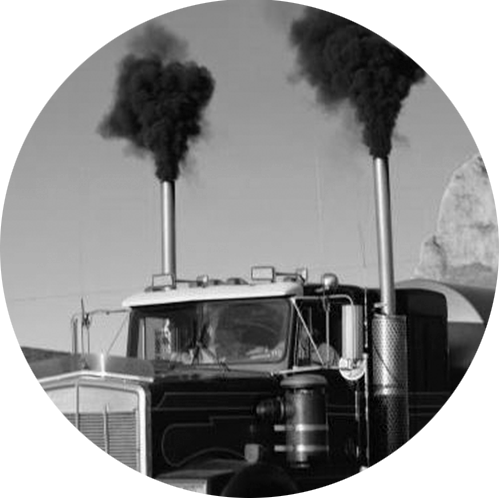
OTHERS – KNOWN CARCINOGEN (IARC 1)
Contents
Diesel Engine Exhaust Profile
QUICK SUMMARY
- A complex mixture of gases and particulates produced from the combustion of diesel fuel in engines
- Associated cancer: Lung cancer
- Most important route of exposure: Inhalation
- Primary sources: Mobile sources (ex. vehicles, ships, trains), stationary area sources (ex. oil and gas production facilities, shipyards), and stationary point sources (ex. chemical manufacturing, electric utilities)
- Occupational exposures: Approx. 966,000 Canadians are exposed at work, primarily in transportation-related occupations
- Environmental exposures: Via outdoor and indoor air; exposures are higher for those living or working near busy roads and highways
- Fast fact: Assessing exposure is complex due to difficulty separating diesel exhaust from other air contaminants with similar characteristics, in addition to controversies in the best practices for measuring exposure.
General Information
Diesel engine exhaust, produced when diesel fuel combusts in a compression ignition engine, is a complex mixture of gases and particulates.[1] The composition of the exhaust depends on a number of factors including the type of engine (heavy or light duty), type of fuel and oil, speed and load of operation, and emission control systems.[1]
Gaseous compounds present in diesel exhaust can include carbon dioxide, water vapour, oxygen, sulphur and nitrogen compounds, carbon monoxide, and low molecular weight hydrocarbons and their derivatives.[2,3] Diesel particulate matter (DPM) may contain elemental carbon, organic compounds (including polycyclic aromatic hydrocarbons, or PAHs), metals, and other trace compounds.[3] Almost all particulate emitted by diesel engines is respirable (PM <10 micron), with the majority having diameters less than 1.0 micron.[1]
The International Agency for Research on Cancer (IARC) classifies diesel exhaust as Group 1, carcinogenic to humans, based on sufficient evidence for lung cancer and limited evidence for bladder cancer in humans.[4] Animal studies also showed increases in lung cancer rates from inhalation of whole engine exhaust and increases in tumour development when particulate was applied to the skin or administered internally.[2] Studies of the gaseous phase (particles removed) were inadequate to determine carcinogenicity.[2]
Although epidemiological evidence supports a link between diesel exhaust and lung cancer, exposure assessment is complex due to the difficulty in isolating diesel exposure from other ambient contaminants with similar characteristics.[2]
Short term exposure to diesel engine exhaust can irritate the eyes, throat, and bronchi, and cause neuro-physiological symptoms such as light-headedness, nausea, and respiratory symptoms.[3] Diesel exhaust may initiate allergic reactions or increase immunological response to other allergens.[3] Increases in hospital admission, higher incidence of respiratory symptoms, and decreases in lung function are all associated with exposures to airborne particulate, including diesel particulate matter.[3] Increased mortality rates are also reported, particularly in the elderly and those with cardiopulmonary conditions.[3] Children living in high traffic areas are at particular risk of respiratory symptoms.[5]
Regulations and Guidelines
Occupational Exposure Limits (OEL)
With the exception of the mining industry, few jurisdictions in Canada have an occupational exposure limit (OEL) for diesel engine exhaust, and none have adopted an OEL that reflects the current state of knowledge. OELs exist for various components of diesel engine exhaust, but there is a regulatory gap for limiting exposure to the carcinogenic fraction, which is mainly found in the particulate matter. Elemental carbon has emerged as the best surrogate for measuring diesel exhaust particulate. Several countries have proposed or adopted exposure limits for measuring elemental carbon, including Switzerland, Germany, and Austria. For more information on OELs for diesel engine exhaust in Canada, please see our our report, “Setting an Occupational Exposure Limit for Diesel Engine Exhaust in Canada: Challenges and Opportunities”.
Adopted or recommended OELs for DEE in Canada[6]
| Jurisdiction | OEL | Marker of exposure | Notes/Policy instrument reference |
| CAN | 8-hr TWA: 1.5 mg/m3 | Respirable combustible dust | |
| BC | 8-hr TWA: 1.5 mg/m3 | Respirable combustible dust | Applies to mines and to to any underground working which is not a mine within the meaning of the Mines Act. |
| SK | 8-hr TWA: 0.16 mg/m3 | Total carbon | Applies to mines, as defined by the Mines Regulations, 2018. |
| ON | 8-hr TWA: 0.4 mg/m3 | Total carbon | Current OEL; applies to all mines, mining plants, and mining development in Ontario. Method: NIOSH 5040. |
| 8-hr TWA: 0.16 mg/m3 | Total carbon; respirable dust | Proposed OEL. Would apply to workplaces in which Regulation 833 applies. Method: NIOSH 5040. | |
| QC | 8-hr TWA: 0.4 mg/m3 | Total carbon | Applies to a mine, as defined by the mining OHS regulations. Method: NIOSH 5040. |
| NL | 8-hr TWA: 0.4 mg/m3 | Total carbon | Applies to underground mines. Measured as per NIOSH Method 5040. |
| NB | 8-hr TWA: 1.5 mg/m3 | Respirable combustible dust | Applies to underground mines. |
| NS | 8-hr TWA: 1.5 mg/m3 | Respirable combustible dust | Applies to non-coal mines. |
| YK | 8-hr TWA: 1.5 mg/m3 | Respirable combustible dust | Applies to mines, as defined under the OSH regulations. |
| NWT | 8-hr TWA: 1.5 mg/m3 | Respirable combustible dust | Applies to mines. |
| NU | 8-hr TWA: 1.5 mg/m3 | Respirable combustible dust | Applies to mines. |
Environment Canada guidelines
| Regulation | Year |
|---|---|
| Sulphur in Diesel Fuel | 2006[7], 2012[8] |
| On-Road Vehicle & Engine Emission | 2002[9] |
| Off-Road Small Spark Ignition Engine Emission | 2003[10] |
| Off-Road Compression Ignition Engine Emission | 2004[11], 2011[12] |
| Marine Spark-Ignition Engine & Off-Road Recreational Vehicle Emission | 2011[13] |
Diesel Fuel Use in Canada
Diesel fuels, produced by refining crude oils, are generally blended and often contain additives to meet specifications for performance.[14] Regulations regarding fuel composition and emission standards in Canada (aligned with the US Environmental Protection Agency) should result in lower diesel exhaust emissions across North America.[15] The regulations, which came into effect on August 31, 2006, require that the sulphur content in fuels sold for on-road use not exceed 15 ppm; fuels used for off-road, locomotive, and marine engines were required to meet the same level by 2012.[16] Lower sulphur content in the fuel leads to lower emissions of particulate matter in the exhaust.
A series of regulations outline allowable emissions for new models of on- and off-road vehicles and engines. These regulations cover applications where diesel fuels are used.[9,13] For example, the On-Road Vehicle and Engine Emission Regulation sets emission standards for particulate matter and nitrogen oxides for on-road heavy-duty truck engines from 2007 and onward. These new standards reduce emission limits by 90% and 95%, respectively, compared with previous standard levels.[15]
Emission standards are met through technological changes including catalytic converters and particle traps.[16] Although the change to ultra-low sulphur fuels will decrease sulphur emissions, significant decreases in diesel particulate matter and other diesel exhaust constituents will not be evident immediately. This is because older technology engines will remain in use until replacement is required.
Environmental Exposures Overview
The primary source of exposure to the general population is from outdoor and indoor air.[3] CAREX Canada’s environmental estimates for diesel exhaust suggest that levels in both indoor and outdoor air result in increased risks of cancer at a population level (data quality very low). Because diesel engine exhaust is not directly measured in Canada, our estimates are developed based on the assumption that 12% of total outdoor fine particles (PM2.5) are attributable to diesel engine emissions.
The three major sources of diesel exhaust are mobile sources (e.g. vehicles, ships, locomotives); stationary area sources (e.g. oil and gas production facilities, stationary engines, repair yards, shipyards); and stationary point sources (e.g. chemical manufacturing, electric utilities). Non-road sources can double the exposure to diesel exhaust in nearby locations.[3]
Data from a Health Canada assessment of respirable particulate matter estimated that over 80% of PM10 emitted from the transportation sector was attributable to diesel engines.[17] Regulating engine performance and fuel formulation has decreased exhaust emissions, however the contributions of increased numbers of vehicles, and increased use of sports utility vehicles (SUVs) in particular, are ongoing concerns.[5]
Diesel engine exhaust also contributes to smog, which is composed primarily of ground level ozone (formed when nitrous oxides and volatile organic compounds, or VOCs, react in sunlight) and particulate matter.[15]
For more information, see the environmental exposure estimate for diesel engine exhaust.
Occupational Exposures Overview
Inhalation is the most important route of occupational exposure.[1]
CAREX Canada estimates that approximately 966,000 Canadians are exposed to diesel exhaust in their workplace. The two largest industrial groups exposed are truck transportation and transit and ground passenger transportation. The largest occupational groups exposed are transport truck drivers, bus drivers, subway operators and other transit operators, heavy equipment operators, and delivery and courier service drivers.
Additional occupations that may be exposed to diesel exhaust from the use of on-road engines include bus and subway drivers, bus garage workers, trucking company workers, forklift operators, firefighters, lumberjacks, toll-booth and parking garage attendants, traffic controllers, car mechanics, taxi drivers, couriers, and other professional drivers.[1,2] Occupations with potential for exposure to non-road diesel engines include railroad workers, underground mine workers (using diesel powered equipment), forestry (loggers), and those in the marine industry.[1,2]
With the exception of the mining industry, few jurisdictions in Canada have an occupational exposure limit (OEL) for diesel engine exhaust, and none have adopted an OEL that reflects the current state of knowledge, according to our report, “Setting an Occupational Exposure Limit for Diesel Engine Exhaust in Canada: Challenges and Opportunities”. Diesel engine exhaust contains up to 1,800 chemicals, making it a complex mixture that is challenging to monitor. However, elemental carbon has emerged as the best surrogate for measuring diesel exhaust particulate and several international jurisdictions have proposed or adopted occupational exposure limits based on measurement of elemental carbon, including Switzerland, Germany, and Austria. Current scientific evidence supports the need for a more protective occupational exposure limit (OEL) for DEE in Canada.
According to the Burden of Occupational Cancer in Canada project, occupational exposure to diesel engine exhaust leads to approximately 560 lung cancers and possibly 200 suspected bladder cancers each year in Canada, based on past exposures (1961-2001).[18,19,20] This amounts to 2.4% of lung cancer cases and 2.7% of suspected bladder cancer cases diagnosed annually. Most occupational lung cancers associated with diesel engine exhaust occur among workers in the mining and oil and gas extraction sector. These cancers also occur among workers in the transportation and warehousing, wholesale and retail trade, and manufacturing sectors. Work-related diesel engine exhaust exposure resulted in approximately $684 million in costs for newly diagnosed lung and suspected bladder cancer cases in 2011.[19]
For detailed estimates of exposure to diesel engine exhaust, see the occupational exposures tab.
Sources
Other Resources
- US Environmental Protection Agency (EPA). Integrated Risk Information System for Diesel Engine Exhaust (2008)
- The National Institute for Occupational Safety and Health (NIOSH). Mining and Safety Health Topic: Diesel Engine Exhaust(2009)
- Health Canada. Evaluation of the Levels of Diesel-related Pollutants on School Buses During the Transportation of Children Executive Summary December (2005) (PDF)
Subscribe to our newsletters
The CAREX Canada team offers two regular newsletters: the biannual e-Bulletin summarizing information on upcoming webinars, new publications, and updates to estimates and tools; and the monthly Carcinogens in the News, a digest of media articles, government reports, and academic literature related to the carcinogens we’ve classified as important for surveillance in Canada. Sign up for one or both of these newsletters below.
CAREX Canada
School of Population and Public Health
University of British Columbia
Vancouver Campus
370A - 2206 East Mall
Vancouver, BC V6T 1Z3
CANADA


As a national organization, our work extends across borders into many Indigenous lands throughout Canada. We gratefully acknowledge that our host institution, the University of British Columbia Point Grey campus, is located on the traditional, ancestral, and unceded territories of the xʷməθkʷəy̓əm (Musqueam) people.