
Titanium Dioxide Profile
METALS – POSSIBLE CARCINOGEN (IARC 2B)
Contents
Titanium Dioxide Profile
General Information
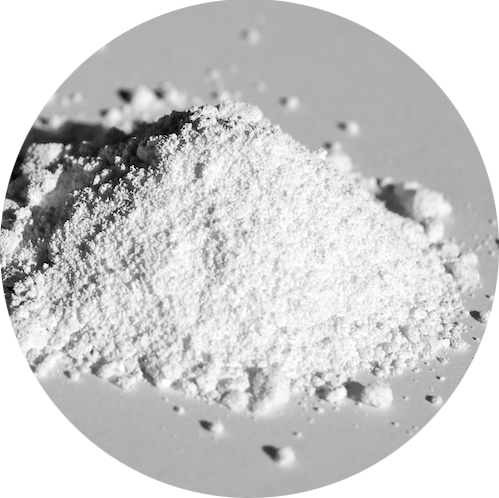
Titanium dioxide is a mineral substance that occurs naturally in the environment when titanium is oxidized. It is found as white crystals or as a powder.[1] It may also be referred to as TiO2, titanium white (when used as a pigment), or titania.[1]
Titanium dioxide has been classified by the International Agency for Research on Cancer (IARC) as Group 2B, possibly carcinogenic to humans. Inhalation exposure in rats caused an increased incidence of lung cancer.[2] Although there were three epidemiological studies available to the IARC working group, all had methodological limitations and none found a significant association between occupational exposure and increased risk of cancer.[2]
Additionally, titanium dioxide may reduce lung function in exposed workers, and cause pleural thickening and mild fibrotic changes.[2] Other health effects include irritation of the eyes, skin and respiratory tract, as well as contact dermatitis and allergic sensitization.[1]
Titanium dioxide was recently identified as an emerging priority for research on carcinogens due to its use in nanomaterials.[3]
Regulations and Guidelines
Occupational exposure limits (OEL) [4,5,6,7,8,9,10,11,12,13,14,15,16,17,18]
| Canadian Jurisdictions | OEL (mg/m3) |
|---|---|
| Canada Labour Code | 10 |
| AB, MB, NL, NS, ON, PE | 10 |
| BC | 10 [t]; 3 [r] |
| NB, QC | 10 [t] |
| NT, NU, SK | 10 20 [stel] |
| YT | 30 [twa, imp]; 10 [twa, g] |
| Other Jurisdictions | OEL (mg/m3) |
| ACGIH 2020 TLV | 10 |
mg/m3 = milligrams per cubic metre
t = total dust
r = respirable fraction
tm = total mass
stel = short term exposure limit (15 min. maximum)
twa = time weighted average
imp = impinger (million particles per cubic foot, or mppcf)
g = gravimetric (mg/m3)
ACGIH = American Conference of Governmental Industrial Hygienists
TLV = threshold limit value (8 hour maximum)
Canadian environmental guidelines
| Jurisdiction | Limit | Year |
|---|---|---|
| Ontario Ambient Air Quality Criteria | 24 hour: 34 µg/m3 | 2016[19] |
| Food Additives Permitted For Use | C – Colouring Agents | 2017[20] |
µg/m3 = micrograms per cubic metre
Canadian agencies/organizations
| Agency | Designation/Position | Year |
|---|---|---|
| Health Canada | DSL – moderate priority substance with the greatest potential for exposure | 2006[21] |
| PMRA list of formulants | List 4B: contains formulants which may be toxic, but will not adversely affect public health and the environment based on use patterns | 2018[22] |
DSL = domestic substances list
Titanium dioxide was not included in other Canadian government guidelines, standards, or chemical listings reviewed.
Main Uses
Titanium dioxide is used primarily as a white pigment in paints, vinyl compounds, enamels, plastics, specialty papers, inks, foods, toothpastes and cosmetics, and skin care products.[2,23] It is the most commonly used pigment worldwide, accounting for 70% of global volume of pigments produced.[23] For optimum pigment properties, particle size is controlled within 0.2 to 0.4 micrometers.[24]
Titanium dioxide is also used in sunscreens to protect skin from ultraviolet (UV) radiation. It is often used in nanoparticle size ranges, since small size increases scattering of UV radiation.[24]
Nanoparticles
Titanium dioxide tends to be used in its ultrafine size range, which are nanoparticles measuring fewer than 100 nanometers. Nanomaterials have unique properties electronically, optically, mechanically, and chemically, which make them useful in a variety of industrial applications. However, the health and environmental effects of these particles are not well understood.[25]
The toxicity of nanomaterials often differs compared to the same compound in a larger size fraction. For example, the two distinct crystalline forms of titanium dioxide (anatase and rutile), differ significantly in toxicity (anatase is 100 times more cytotoxic than rutile).[25]
Ultrafine titanium dioxide has different shapes, sizes, and crystalline structures depending on how it’s being applied.[25] The nanoparticles of titanium dioxide can exist in shapes such as spheres, rods, wires, and agglomerates, and they can be coated with other chemicals, such as alumina.[25]
Canadian Production and Trade
Canada’s capacity to produce titanium dioxide was over 100,000 tonnes in 2015, and between the years of 2011 and 2014, Canada provided 37% of the titanium dioxide used in the United States.[24]
QIT-Fer et Titane operates an ilmenite mine (called Tio) located near Havre-Saint-Pierre, Quebec.[26] QIT also operates a metallurgical complex to process the ilmenite ore into titanium slag in nearby Tracy, Quebec.[26]
Production and trade
| Activity | Quantity | Year |
|---|---|---|
| Export | 11,192 t of ‘titanium oxides’ | 2021[27] |
| Import | 13,526 t of ‘titanium oxides’ | 2021[27] |
t = tonne
Environmental Exposures Overview
Titanium dioxide is the most common form of titanium, which is the ninth most abundant element in the earth’s crust.[28] The main source of environmental exposure to titanium dioxide is dermal absorption from sunscreens, cosmetics, paints, and enamels; ingestion is also a potential source via these same products.[2] Although most Canadians will be exposed to titanium dioxide via sunscreen, dermal absorption is not expected to carry the same risk as inhalation exposures.[1] Populations living in close proximity to titanium mines and industrial plants may be at higher risk of exposure.
Titanium dioxide is not reportable to Environment Canada’s National Pollutant Release Inventory.[29]
A search of the US Consumer Product Information Database yielded the following results on current potential for exposure to titanium dioxide in Canada:
US Consumer Product Information Database
| US Consumer Products 2015[30] | ||
|---|---|---|
| Results: > 2,380 products | ||
| Search Term | Quantity | Product Type |
| ‘titanium dioxide’ | 2,380 | Paint, make-up, caulking, sunscreens, toothpastes |
Occupational Exposures
Inhalation and dermal absorption are the most important routes of occupational exposure to titanium dioxide.[1]
The main occupations exposed include workers at titanium mines, titanium dioxide production (particularly milling and packaging), as well as site cleaning and maintenance.[2] The primary concern for exposure to titanium dioxide is inhalation; titanium dioxide found in powder or dust form can be aerosolized leading to increased exposure risk. If bound in another product, exposures are expected to be low.[2]
CAREX Canada has not prioritized titanium dioxide for exposure estimate development. This is because there is a lack of exposure monitoring data in the Canadian Workplace Exposure Database on which to base an estimate.
Sources
Subscribe to our newsletters
The CAREX Canada team offers two regular newsletters: the biannual e-Bulletin summarizing information on upcoming webinars, new publications, and updates to estimates and tools; and the monthly Carcinogens in the News, a digest of media articles, government reports, and academic literature related to the carcinogens we’ve classified as important for surveillance in Canada. Sign up for one or both of these newsletters below.
CAREX Canada
School of Population and Public Health
University of British Columbia
Vancouver Campus
370A - 2206 East Mall
Vancouver, BC V6T 1Z3
CANADA


As a national organization, our work extends across borders into many Indigenous lands throughout Canada. We gratefully acknowledge that our host institution, the University of British Columbia Point Grey campus, is located on the traditional, ancestral, and unceded territories of the xʷməθkʷəy̓əm (Musqueam) people.