
Polychlorinated Biphenyls Profile
INDUSTRIAL CHEMICALS – KNOWN CARCINOGEN (IARC 1)
Contents
Polychlorinated Biphenyls Profile
General Information
Polychlorinated biphenyls (PCBs) are a group of chemicals made up of 209 isomers.[1] Synthetic compounds, they are similar in structure but vary considerably in their physical properties.[1,2] PCBs may be oily liquids or solids that are colourless to white, depending on the exact chemical make-up.[1] They are very stable and persist in the environment.[3] Polychlorinated biphenyls may also be referred to as chlorobiphenyls, chlorinated biphenyls or Aroclor, a commercial name.[4] There are numerous other synonyms and product names; see the Hazardous Substances Data Bank (HSDB) for more information.[4]
PCBs as a group have been classified by the International Agency for Research on Cancer (IARC) as Group 1, carcinogenic to humans.[5] This classification is based on consistent associations between PCB exposure and increased risk of melanoma in humans.[5] There is also limited evidence from some studies suggesting that exposure is linked to increased risks of non-Hodgkin lymphoma and breast cancer.[5] The first PCB classified by IARC was 3,3′,4,4′,5-pentachlorobiphenyl (PCB-126); it was classified in 2012 as Group 1, based on strong mechanistic evidence for genotoxicity.[6]
PCB exposure may irritate the skin and at high levels can cause liver damage.[7] Stored in fatty tissues, PCBs can build up to concentrations far exceeding those found in the environment.[7] Little is known about the long-term health impacts of exposure to PCBs, since most observed health effects have resulted from short-term and high-level accidental or occupational exposures.[2]
Regulations and Guidelines
Occupational exposure limits (OEL)[8,9,10,11,12,13,14,15,16,17,18,19,20,21,22]
| Canadian Jurisdictions | OEL (mg/m3) |
|---|---|
| Canada Labour Code | 1 [42% Cl, sk] 0.5 [54% Cl, sk] |
| AB, BC, MB, NB, NL, NS, PE, QC | 1 [42% Cl, sk] 0.5 [54% Cl, sk] |
| QC | 1 [42% Cl, sk, em] 0.5 [54% Cl, sk, em] |
| YT | 1 [42% Cl, sk]; 2 [stel, sk] 0.5 [54% Cl, sk]; 1 [stel, sk] |
| ON | 0.05 |
| NU, SK, NT | 1 [42% Cl, sk]; 3 [stel, sk] 0.5 [54% Cl, sk]; 1.5 [stel, sk] |
| Other Jurisdiction | OEL (mg/m3) |
| ACGIH 2020 TLV | 1 [42% Cl, sk] 0.5 [54% Cl, sk] |
mg/m3 = milligrams per cubic meter
Cl = chlorine
sk = easily absorbed through the skin
stel = short term exposure limit (15 min. maximum)
em = exposure must be reduced to the minimum
ACGIH = American Conference of Governmental Industrial Hygienists
TLV = threshold limit value
All exposure limits are defined in the legislation as chlorodiphenyl except for Ontario that defines the limit as polychlorinated biphenyls.
Canadian environmental guidelines and standards*
| Jurisdiction | Limit | Year |
|---|---|---|
| Canadian Drinking Water Guidelines | Archived** | 2008[23] |
| Ontario Drinking Water Standards | 0.003 mg/L | 2003[24] |
| Ontario Ambient Air Quality Criteria | 24 hour: 0.15 µg/m3 | 2016[25] |
| Annual: 0.035 µg/m3 | 2012[25] | |
| BC’s Contaminated Sites Regulation, BC Reg 375/96 | Sets soil standards for the protection of human health: Agricultural and low density residential sites: 5 μg/g Urban park and high density residential sites: 10 μg/g Commercial sites: 35 μg/g Industrial sites: 900 μg/g | 2017[26] |
µg/L = micrograms per litre
µg/m3 = micrograms per cubic meter
µg/g = micrograms per gram
IMAC = interim maximum allowable concentration
*Standards are legislated and legally enforceable, while guidelines (including Ontario ambient air quality criteria) describe concentrations of contaminants in the environment (e.g. air, water) that are protective against adverse health, environmental, or aesthetic (e.g. odour) effects
**Health Canada defines archived parameter as “parameters which are no longer found in Canadian drinking water supplies at levels that could pose a risk to human health, including pesticides which are no longer registered for use in Canada, and for mixtures of contaminants that are addressed individually.”
Canadian agencies/organizations
| Agency | Designation/Position | Year |
|---|---|---|
| Health Canada | DSL – low priority substance (previously assessed/risk managed) | 2006[27] |
| CEPA | Schedule 1, paragraphs ‘a’, ‘b’, and ‘c’ | 2012[28] |
| National Classification System for Contaminated Sites | Rank = “High hazard” | 2008[29] |
| Canada-Ontario Agreement on Great Lakes Water Quality and Ecosystem Health | Tier 1 chemical: targeted for virtual elimination | 2014[30] |
DSL = domestic substance list
CEPA = Canadian Environmental Protection Act
Polychlorinated biphenyls were not included in other Canadian government guidelines, standards, or chemical listings reviewed.
Main Uses
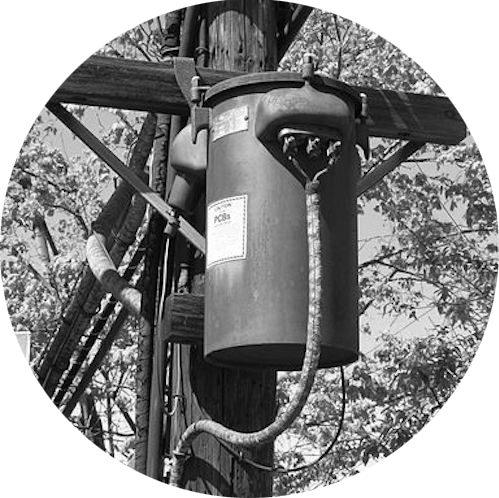
The stable, relatively fire-resistant, and non-corrosive properties of PCBs have made them useful in a wide range of applications.[31] Historically, PCBs were used extensively to make industrial materials such as sealing and caulking compounds, cutting oils, inks, and paint additives.[32] They were also used to produce coolants and lubricants for certain kinds of electrical equipment, such as transformers and capacitors.[32]
Historically in Canada, PCBs were widely used to manufacture electrical equipment, heat exchangers, hydraulic systems, and several other specialized applications.[33]
According to Canadian legislation from 1980 and 1985, the only permissible use of PCBs is in older equipment, such as refrigerators, until the end of that equipment’s service life.[33,34] The maximum allowable concentration of PCBs per equipment is 50 parts per million by weight.[34] The equipment must have been designed to use PCBs at the time that it was imported, manufactured or knowingly offered for sale.[34]
There was a 72% decrease in the amount of PCBs used or stored in Canada from 2012 to 2014. In 2014, 111 tonnes of PCBs were stored, 51 tonnes were in use, and 716 tonnes were destroyed.[35]
Canadian Production and Trade
Canada has never manufactured PCBs, but imported approximately 40,000 tonnes annually from 1929 until the 1970s.[31]
In 2002, the Canadian Working Group, Great Lakes Binational Toxics Strategy, classified three major industry sectors that needed to be targeted for PCB destruction, due to high levels of PCB storage. They include provincial and municipal governments, iron and steel manufacture, and forestry, pulp, and paper industries.[36,37]
In 2008, legislative efforts concentrated on preventing further production of PCBs, contamination of the environment, and destruction of currently stored PCBs.[34] Standardized waste management procedures have been developed[38] and many companies specialize in PCB disposal.[39]
Production and trade
| Activity | Quantity | Year |
|---|---|---|
| Export | 0 t of ‘mixtures and preparations containing polychlorinated biphenyls PCBs, PCTs or PBBs’ | 2021[40] |
| Import | 38 t of ‘mixtures and preparations containing polychlorinated biphenyls PCBs, PCTs and PBBs’ | 2021[40] |
t = tonnes
PCT = polycyclohexylenedimethylene terephthalate
PBB = polybrominated biphenyls
Environmental Exposures Overview
Inhalation, dermal contact, and ingestion are potential routes of exposure to PCBs for the general population.[1] All Canadians have PCBs in their bodies due to exposure to small amounts present in food, air, soil, and water.[32] The greatest source of PCB exposure for Canadians is consuming contaminated foods.[32,41]
Due to PCBs’ persistence and bioaccumulation potential, the highest concentrations are found in animals at the top of the food chain.[32] Foods found to contain high concentrations of PCBs include fish (particularly sport fish caught in contaminated lakes or rivers), meat, and poultry.[3] A survey on PCB concentrations in food, conducted in Vancouver in 2002, found that freshwater fish and marine fish carried the highest concentrations of PCBs.[42,43]
According to Health Canada, the average daily dietary intake of PCBs is estimated to be less than ½ a millionth of a gram.[32] Individuals who consume large amounts of fish, wildlife, or marine mammals may be exposed to higher concentrations.[32] Infants may also be exposed to PCBs through breast milk.[3] A study looking at over 300 breast milk samples collected between 1992 and 2005 across Canada found that median levels of PCBs declined significantly between 2002-2005.[44] This was at the lower end of the concentration range reported in industrialized nations.[45] CAREX Canada estimates that PCB levels in food and beverages result in an increased risk of cancer in Canada (very low data quality).
PCBs have been found in runoff, sediment, soil, rivers, creek water, lakes, leachate, pond effluents, landfills, and an underground oil-water layer.[1,46] There are no known natural sources of PCBs in the environment:[41] the widespread prevalence of PCBs in the environment is due to prior industrial use and their environmental persistence.[1] A 2007 study investigated PCB levels in Ontario rain, snow and surface waters.[47] All samples were positive for PCBs. Concentrations varied between urban and rural areas; greater concentrations were found in urban areas. However, PCBs are still found in remote areas of Canada due to long-range transport by global air currents.[32] Currently, there is insufficient measured data for CAREX Canada to produce environmental exposure estimates for PCBs in drinking water (data gap).
CAREX Canada estimates that PCB levels in outdoor air is negligible, however, PCB levels in indoor air result in an increased risk of cancer (data quality very low). In addition, we estimate that PCB levels in indoor dust do not result in an increased risk of cancer (data quality very low).
PCB release is not reportable to the National Pollutant Release Inventory in Canada.[48] No household products containing PCBs were listed in the Consumer Product Information Database from the United States.[49]
For more information, see the environmental exposure estimate for polychlorinated biphenyls.
Occupational Exposures Overview
Inhalation, dermal absorption and ingestion are all potential routes of occupational exposure to PCBs.[1]
CAREX Canada estimates that approximately 8,00 Canadians are exposed to polychlorinated biphenyls in their workplaces. The largest industrial groups exposed are building equipment contractors (e.g. electricians) and electric power generation, transmission, and distribution. Other important industries exposed to PCBs are utility system construction, public administration, and foundation, structure, and building exterior contractors.
The largest occupational groups exposed to PCBs include industrial electricians, contractors and supervisors in electrical and telecommunication trades, electrical power line and cable workers, and electrical mechanics. Other occupational exposures may occur in workers involved in waste storage and incineration, and contaminated site remediation.[3,32] Welders and general maintenance workers in various industries may also encounter PCBs in old industrial paints and coatings.[3] Exposure may also occur during accidental spills or fires involving equipment containing PCBs.[1,7]
For more information, see the occupational exposure estimate for polychlorinated biphenyls.
Sources
Photo: Wikimedia Commons, Sturmovik

Other Resources
- Health Canada. Total Diet Survey Study Publication Page (2016)
Subscribe to our newsletters
The CAREX Canada team offers two regular newsletters: the biannual e-Bulletin summarizing information on upcoming webinars, new publications, and updates to estimates and tools; and the monthly Carcinogens in the News, a digest of media articles, government reports, and academic literature related to the carcinogens we’ve classified as important for surveillance in Canada. Sign up for one or both of these newsletters below.
CAREX Canada
School of Population and Public Health
University of British Columbia
Vancouver Campus
370A - 2206 East Mall
Vancouver, BC V6T 1Z3
CANADA


As a national organization, our work extends across borders into many Indigenous lands throughout Canada. We gratefully acknowledge that our host institution, the University of British Columbia Point Grey campus, is located on the traditional, ancestral, and unceded territories of the xʷməθkʷəy̓əm (Musqueam) people.