
Refractory Ceramic Fibres Profile
FIBERS AND DUSTS – POSSIBLE CARCINOGEN (IARC 2B)
Contents
Refractory Ceramic Fibres Profile
General Information
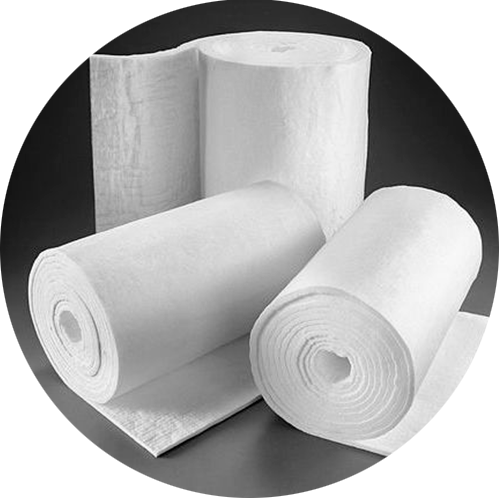
Refractory ceramic fibres (RCFs) belong to a class of fibres called man-made vitreous fibres, which are primarily valued for their insulating qualities.[1] Raw refractory ceramic fibres are white or gray fibrous materials supplied in bulk fibre, blanket form, or contained in a solid product.[2]
RCFs are produced when raw materials (kaolin clay, Al2O3, SiO2 and sometimes ZrO2) are melted, then spun or blown into alumino-silicate fibres with average diameters between 1.2 to 3.5 micrometers (μm).[2] The fibres differ from natural mineral fibres like asbestos in that they have an amorphous structure (i.e. not crystalline) and they tend to be less durable.[2,3] At temperatures above 1,000°C, RCFs can be transformed into crystalline silica (cristobalite).[2] Please refer to the CAREX Canada profiles for Silica (Crystalline) and Asbestos for more information about these substances.
Refractory ceramic fibres have been classified by the International Agency for Research on Cancer (IARC) as Group 2B, possibly carcinogenic to humans, based on an increased risk of lung cancer and mesothelioma in experimental animals.[1] Pleural plaques, common in asbestos-exposed workers, may also arise in people working with RCFs.[1]
Additional adverse health effects from inhalation exposure to RCFs include respiratory irritation, often resulting in sore throat, nasal congestion, and cough.[2] Dermal exposure can result in contact dermatitis and itching.[4]
Regulations and Guidelines
Occupational exposure limits (OEL)[5,6,7,8,9,10,11,12,13,14,15,16,17,18,19]
| Canadian Jurisdictions | OEL (f/cc) |
|---|---|
| Canada Labour Code | 0.2 |
| AB, BC, MB NL, NS, PE, NT | 0.2 |
| ON | 0.5 |
| QC | 1 |
| NU, SK | 0.2 [ds] |
| NB | – |
| YT | Not listed |
| Other Jurisdiction | OEL (f/cc) |
| ACGIH 2020 TLV | 0.2 |
f/cc = fibres per cubic centimeter, where fibres are longer than 5 micrometers (µm) and have aspect ration of 3:1 or greater
ds = designated substance
ACGIH = American Conference of Governmental Industrial Hygienists
TLV = threshold limit value
Canadian environmental guidelines
| Jurisdiction | Limit | Year |
|---|---|---|
| Residential Indoor Air Quality | Minimize exposure during renovations and installations. Materials and products to be examined for deterioration. | 1987[20] |
Canadian agencies/organizations
| Agency | Designation/Position | Year |
|---|---|---|
| CEPA | Schedule 1, paragraph ‘c’ (human health) | 1999[21] |
CEPA = Canadian Environmental Protection Act
Refractory ceramic fibres were not included in other Canadian government guidelines, standards, or chemical listings reviewed.
Main Uses
Because of their high thermal resistance, refractory ceramic fibres are used in high temperature applications such as furnace linings and doors, kilns, catalytic converters, brake pads, and heat shields.[2]
Canadian Production and Trade
There are several organizations in Canada that produce or use refractory ceramic fibers. These include Canadian Ferro Refractories Inc., FibreCast Inc., Pyrotek Inc., Thermal Ceramics, and Wolf Steel Ltd.[22]
Environmental Exposures Overview
The general public’s exposure to refractory ceramic fibres is expected to be low. However, uncertainty about releases and environmental concentrations prompted the Canadian Environmental Protection Act (CEPA) to conclude in 1993 that RCFs may enter the environment in quantities or under conditions that may constitute a danger in Canada to human life or health.[3] Potential sources of environmental exposure include inhaling fibres when materials containing RCFs are physically disturbed.[4]
Lack of data on RCF concentrations in Canadian air, water, sediment, or soil prompted an agreement between the Canadian government and the RCF industry to monitor environmental exposures for a five year period, originally beginning in 2002 but later updated and resigned in 2006 and 2013, respectively.[23,24] Annual reports from the agreement found that airborne RCF levels were significantly below the maximum allowable fenceline air concentration (0.05 fibres/cc), and that all companies implemented procedures to ensure proper maintenance and inspection of pollution control equipment. [22]
RCF releases are not reportable to the National Pollutant Release Inventory.[25] One consumer product containing RCF (an automotive sealant) was found in the US Consumer Product Information Database.[26]
Occupational Exposures Overview
Inhalation is the most important route of exposure to refractory ceramic fibres in occupational settings.[27]
CAREX Canada estimates that approximately 2,600 Canadians are exposed to RCFs in their workplaces. The largest industrial groups exposed are iron, steel, and ferro-alloy manufacturing, followed by other fabricated metal product manufacturing and building finishing contractors.
Workers typically exposed to RCF are involved in manufacturing, processing, or using products and equipment containing RCFs.[27] he largest occupational groups exposed to RCF include insulators, welders and related machine operators, labourers in mineral and metal processing, and machine operators in mineral and metal processing. Other potentially exposed workers are involved in installing high-temperature insulation materials, demolition work, and maintenance and repair.[4]
Removing RCF insulating material from industrial furnaces and walls has resulted in some of the highest concentrations measured in occupational settings.[4]
For more information, see the occupational exposure estimate for refractory ceramic fibres.
Sources
Photo: Wikimedia Commons, Unifrax

Other Resources
National Library of Medicine. PubChem (Search term: “synthetic vitreous fibers”)
International Programme on Chemical Safety (IPCS) INCHEM. Environmental Health Criteria 77: Man Made Mineral Fibres(1988)
Subscribe to our newsletters
The CAREX Canada team offers two regular newsletters: the biannual e-Bulletin summarizing information on upcoming webinars, new publications, and updates to estimates and tools; and the monthly Carcinogens in the News, a digest of media articles, government reports, and academic literature related to the carcinogens we’ve classified as important for surveillance in Canada. Sign up for one or both of these newsletters below.
CAREX Canada
School of Population and Public Health
University of British Columbia
Vancouver Campus
370A - 2206 East Mall
Vancouver, BC V6T 1Z3
CANADA


As a national organization, our work extends across borders into many Indigenous lands throughout Canada. We gratefully acknowledge that our host institution, the University of British Columbia Point Grey campus, is located on the traditional, ancestral, and unceded territories of the xʷməθkʷəy̓əm (Musqueam) people.